Key points
- DeepX CEO cites a 25 to 40 degree Celsius temperature gap versus rival chips.
- The DX-M1 processor is manufactured on Samsung 5nm process technology.
- Mass production for the next-generation DX-M2 chip targets the second half of 2027.
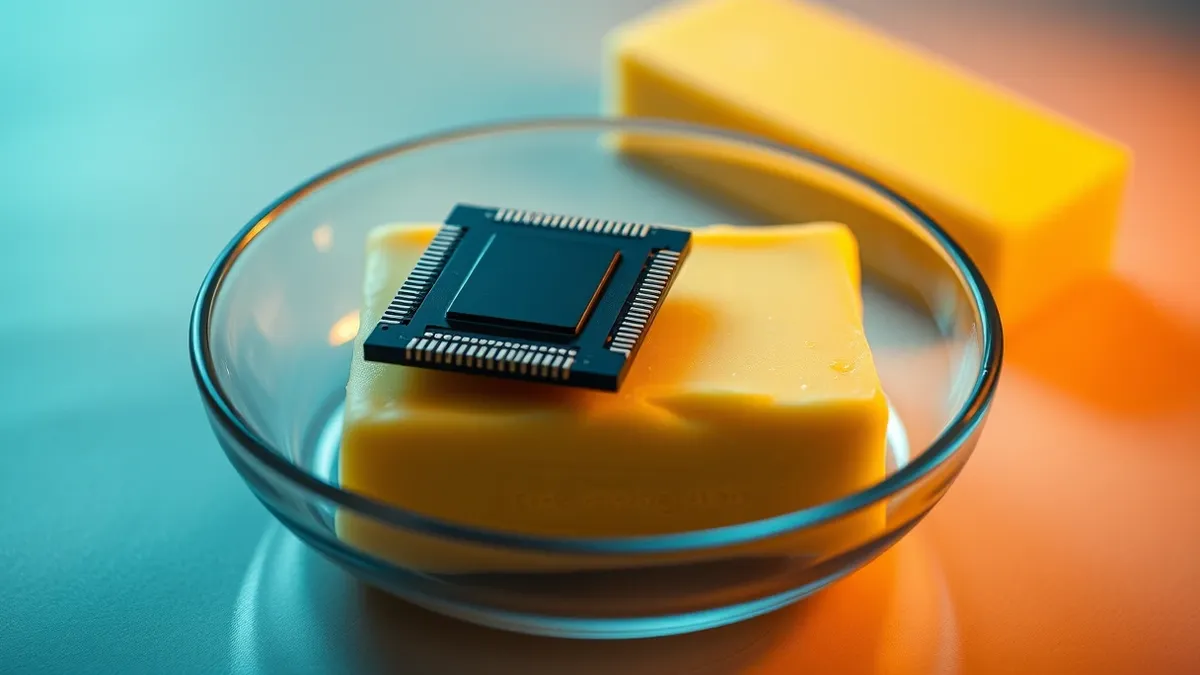
South Korean startup DeepX claims its DX-M1 AI processor runs significantly cooler than competing chips, a capability it demonstrated using a block of butter as a thermal indicator.reported According to Tom's Hardware, the company presented this dairy-based benchmark to highlight efficiency differences in data center hardware.reportedDeepX uses a butter melting test to show its AI chip runs much cooler than others.DeepX asserts its DX-M1 NPU achieves a 25-40C thermal delta over competitors under identical AI workloads.
Evidence: reported
Bizarre AI chip demo uses butter to highlight how new chip runs 40 degrees cooler than the competitionaifleet-tomshardware
Evidence: reported
Bizarre AI chip demo uses butter to highlight how new chip runs 40 degrees cooler than the competitionaifleet-tomshardware
The claim
DeepX CEO Kim Nok-won stated that the DX-M1 NPU maintains lower temperatures than unnamed rival processors while handling identical AI workloads.reported In a side-by-side demonstration reported by Tom's Hardware, competitor chips caused the butter to melt quickly, whereas the butter atop the DeepX solution remained solid.reported Kim asserted a temperature difference of 25 to more than 40 degrees Celsius compared with competitors.reported
Evidence: reported
Bizarre AI chip demo uses butter to highlight how new chip runs 40 degrees cooler than the competitionaifleet-tomshardware
Evidence: reported
Bizarre AI chip demo uses butter to highlight how new chip runs 40 degrees cooler than the competitionaifleet-tomshardware
Evidence: reported
Bizarre AI chip demo uses butter to highlight how new chip runs 40 degrees cooler than the competitionaifleet-tomshardware
The response
Tom's Hardware noted significant gaps in the comparison data, specifically questioning the processing speed of each chip during the test. The outlet observed that any processor can run cooler if power and clock speeds are reduced, a practice common among PC enthusiasts who undervolt hardware for better thermals and reduced noise. This raises uncertainty about whether the cooling advantage comes from efficiency or reduced performance.
Why this matters now
The demonstration addresses growing global concerns about AI data center proliferation and their environmental impact. CNBC reported that hot-running processors drive extensive power and cooling apparatus needs, shaping business, politics and environmental outcomes.reported DeepX positions its design as a direct answer to these thermal challenges by making the chips themselves run cooler.
What buyers should weigh
Enterprise IT buyers should evaluate the trade-off between thermal efficiency and computational throughput. While lower operating temperatures can reduce cooling infrastructure costs, the lack of performance metrics in the demo leaves the actual AI workload capacity unclear. Buyers must verify if the cooling advantage stems from architectural efficiency or throttled performance. Additionally, the DX-M1 is produced on Samsung 5nm, with orders reportedly reaching $13.3 million, indicating early market validation despite the unconventional testing method.reported
Evidence: reported
Bizarre AI chip demo uses butter to highlight how new chip runs 40 degrees cooler than the competitionaifleet-tomshardware
Why it matters
- Lower chip temperatures could reduce data center cooling infrastructure costs and energy consumption for enterprise deployments.
- Unverified performance metrics in thermal demos create risk for buyers prioritizing raw AI compute speed over efficiency.
- Early orders of $13.3 million for the DX-M1 suggest initial vendor interest in alternative thermal solutions.
- The planned H2 2027 mass production of the DX-M2 on Samsung 2nm indicates a roadmap for future efficiency gains.
Topics: AI chips, data centers, thermal management, DeepX, Samsung
Updated
Then / now / next
Data center designs relied on extensive cooling apparatus for hot-running AI processors.
DeepX demonstrates a processor that keeps butter solid during identical AI workloads.
Buyers will watch for mass production of the DX-M2 chip in the second half of 2027.
Story timeline
- Then Data center designs relied on extensive cooling apparatus for hot-running AI processors.
- 09 Nov 2026 Bizarre AI chip demo uses butter to highlight how new chip runs 40 degrees cooler than the competition
- Now DeepX demonstrates a processor that keeps butter solid during identical AI workloads.
- Next Buyers will watch for mass production of the DX-M2 chip in the second half of 2027.
The strongest doubt
Counterpoint from the sources
Tom's Hardware questioned the validity of the thermal comparison, noting that reduced clock speeds can artificially lower temperatures without improving true efficiency.
For readers
Business
- Cooler chips may reduce data center cooling infrastructure costs
- Early orders of $13.3 million indicate market interest in the DX-M1
Investors
- DeepX plans next-gen DX-M2 chip mass production for H2 2027
- Company utilizes Samsung 5nm and future 2nm process nodes
Researchers
- Dairy-based thermal benchmarks highlight efficiency differences
- Undervolting practices complicate direct thermal performance comparisons
Ask the article
Local keyword search of this article; no generated answers.Did this article give you the evidence you needed?
Your choice stays on this device. No public tally.Terms in this story
NPU
Neural Processing Unit, a specialized processor for AI workloads
Undervolt
Reducing voltage supplied to a chip to improve efficiency and thermals
Samsung 5nm
A semiconductor manufacturing process node used for chip production
Questions readers ask
How much cooler does DeepX claim its chip runs compared to competitors?
DeepX CEO Kim Nok-won claims a temperature difference of 25 to more than 40 degrees Celsius.
What process node is used for the DX-M1 processor?
The DX-M1 processor is produced on Samsung 5nm technology, according to The Elec reports.
When is the next-generation DX-M2 chip expected to enter mass production?
DeepX aims to begin mass production of the DX-M2 chip in the second half of 2027.
Connected stories
Reading receipt
- DeepX CEO cites a 25 to 40 degree Celsius temperature gap versus rival chips.
- The DX-M1 processor is manufactured on Samsung 5nm process technology.
- Mass production for the next-generation DX-M2 chip targets the second half of 2027.
Still open: What are the specific clock speeds and power limits used during the butter demonstration?
Still open: How does the DX-M1's AI inference latency compare to the rival chips that melted the butter?